



For a complete, up-to-date list go to the new partial capo super-site site at www.partialcapo.com
Educating the world about partial capos since 1980. |
We no longer carry all types of partial capos. |
Find out how the partial capo can improve your music. |
Don't miss the new "Capo Voodoo Book" series by partial capo pioneer Harvey Reid |
This chart can help you understand the various capos. |
PARTIAL CAPOS |
CAPO |
PROS |
CONS |
OUR PRICE |
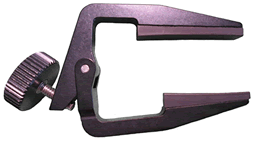 |
Liberty FLIP Model 43 Reversible design does the job of 3 partial capos. Can clamp 3 or 4 middle strings on most guitars, and outer 4 strings on many.
|
Extremely durable, versatile, light-weight and easy to operate. Fits more guitars at more frets, and works as full & partial capo on mandolin family, uke and banjo also. Can do most of what matters in the world of partial capos. |
Slower to operate than spring capos, but better in every other way. |
|
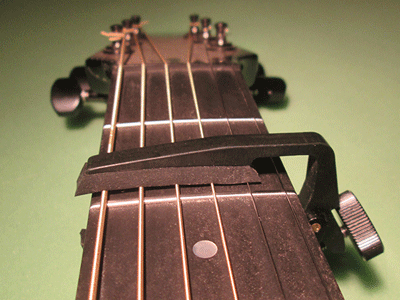 |
Liberty FLIP Model 65 Works as a full capo for steel-string (radiused) guitars, or as a 5-string partial capo. Matches the ground-breaking Model 43
|
The most durable, lightweight, versatile, accurate and lowest profile capo. Radiused full capo on one side, a 5-string partial on the other. |
Slower to operate than spring capos, but better in every other way.
Download a comparison PDF of 4/5-string capos |
|
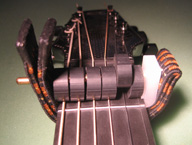 |
Third Hand (Universal)
|
The original and most universal partial capo. From 1976 till 2016 it did its job. Clumsy and very visible, it let you clamp any combination on a huge variety of instruments. |
Hard to reach over, slow to operate, hard to control clamping force, elastic weakens. Read a careful comparison of Third Hand & Spider capos |
|
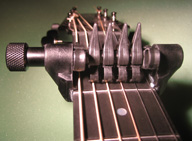 |
Spider Capo (Universal) new in 2008 |
Universal partial capo , and you can flip the levers
while it's on your guitar!, no elastic to wear out. Has more "space-age" look than Third
Hand |
Can't handle wide neck or 12-string
12-string. Slower to operate than Third Hand, levers are easily bumped. Expensive. Read a careful comparison of Third Hand & Spider capos |
|
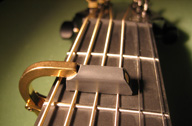 |
Shubb (Esus - 3 inner strings) |
Very low-profile, easy to reach over & behind,
very durable. Can form Esus chord or A chord if flipped around. A fine Esus capo. |
Requires 2 hands to put on or move |
|
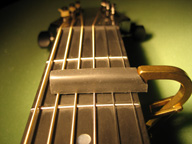 |
Shubb model c8b (5 outer strings) |
Very strong, durable, low-profile, can be easily shortened or notched for
custom capos. Can sometimes use as banjo or mandolin capo. |
Requires 2 hands to put on or move. Usually can't reliably clamp just 4 outer strings without problems. |
 |
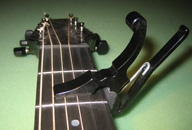 |
Kyser "Shortcut" Capo (Esus - 3 inner strings) |
Can be put on or moved with one hand, even in mid-song. Can form
Esus chord or A chord if flipped around. Does the same things as the Shubb Esus. |
Harder to reach over, spring mechanism weakens with age, may pull sideways, may
not hold heavier strings or 12-string. Compare Shubb & Kyser Esus capos |
|
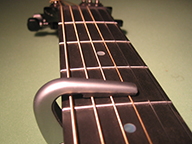 |
G7 "Newport #3" Capo (Esus - 3 inner strings) |
Attractive, low profile,easy to reach around, good tone from rubber. |
Very poor string clearance, hits bass string if you use it at higher frets. Easy to bump out of position. |
|
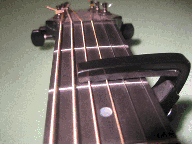 |
Planet Waves "Trio" Clamps 5 strings on bass or treble side -- may also clamp 4 outer strings |
Strong, durable, low-profile, lightweight, inexpensive, attractive. Also a banjo, uke or mandolin capo. |
Few disadvantages. Screw can fall out and get lost. Only available in black. |
|
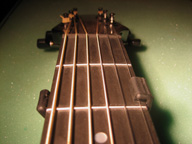 |
Woodie's "G-Band" Model 1 Capo single outer string |
Very low-profile, easy to reach around, does a number of unique and useful
things, inexpensive |
Sometimes shifts out of position, does not fit wide necks, has trouble
higher up on some neck shapes |
|
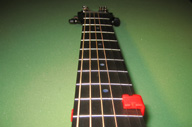 |
Woodie's "G-Band" Model 2 Capo 2 outer strings |
Very low-profile, easy to reach around, inexpensive |
Sometimes shifts out of position, does not fit wide necks, has trouble
higher up on some neck shapes |
|
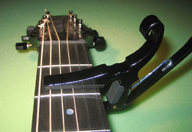 |
Kyser "Drop D" Capo (5 or 4 strings) |
Very fast operation, can store on headstock or strap. Can attach from either side of fingerboard. |
Weaker clamp mechanism, hard to reach over, difficult to shorten
or modify. Can't reliably clamp just 4 outer strings without problems. |
|
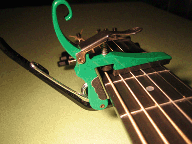 |
Kyser K-Lever GREEN Capo "Drop D" (5 strings) |
Has extra lever to fret under the capo. (as long as you press it with your finger) Allows more
musical possibilities. |
Difficult to shorten or modify, hard to reach over, expensive, obtrusive |
DIscontinued |
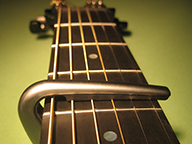 |
G7 "Newport #5" Capo (5 outer strings from either side) |
Attractive, low profile,easy to reach around, good tone from rubber. |
Very poor string clearance, hits bass string if you use it at higher frets. Easy to bump out of position. |
|
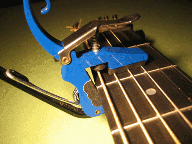 |
Kyser K-Lever BLUE Capo "Esus" (3 inner strings) |
Has extra lever to fret under the capo. (as long as you press it with your
finger) Allows more musical possibilities. |
Difficult to shorten or modify, hard to reach over, expensive, obtrusive |
DIscontinued in 2014 |
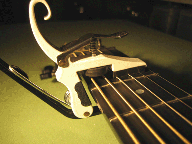 |
Kyser K-Lever WHITE Capo "Open G " (3 inner strings) |
Has extra lever to fret under the capo. (as long as you press it with your
finger) Allows more musical possibilities. |
Difficult to shorten or modify, hard to reach over, expensive, obtrusive |
DIscontinued in 2014 |
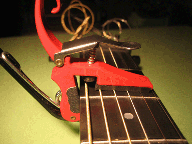 |
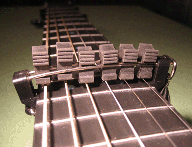
Kyser K-Lever RED Capo "Double Drop D" (middle 4 strings) |
Has extra lever to fret under the capo. (as long as you press it with your
finger) Allows more musical possibilities. |
Hard to reach over, expensive. Not musically as useful as other
partial capos. |
DIscontinued in 2014 |
 |
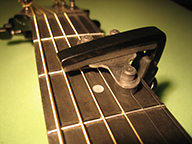
Bob Kilgore's Harmonic Capo (Universal) |
Clamped at fret 5, 7 or 12 it can sound harmonics. Makes really amazing
sounds that don't seem possible. |
Fussy to set up- may not fit all neck shapes (at 12th fret) easily bumped
out of position |
|
 |
Capo Clip (various) |
Unique, can do things no other capo can do. Comes in several models shaped like E, D, G, C chords. Can be moved around & rotated for new ideas. |
Requires another capo to hold it down, small parts fall off and are easy to lose, easy to bump out of position, can be unstable. |
|
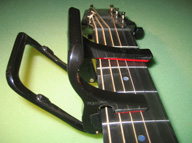 |
"Transpo" Capo (Esus - 3 string) |
Allows very fast access to Esus configuration in keys of E, F, F# and G |
Cannot flip around to form A chord, only works on a few frets, and does
not work well on short or long-scales. Spring mechanism weakens. Expensive. |
NOT AVAILABLE ANYWHERE |

[Home]